Thursday, 3 March 2016

Jaikumar Pareta's International Achievements from world's leading universities

Jaikumar pareta 
Assistant professor at Geetanjali University Udaipur. 
Involved in research and evaluation of polyherbal drugs. Author of more than twenty internationally published medical books.


My Achivements

JAIKUMAR PARETA'S INTERNATIONAL COURSES  FROM WORLD'S LEADING UNIVERSITIES (SUCCESSFULLY COMPLETED WITH PASSING GRADE )
(United kingdom, South Africa, New zealand,Vietnam, etc)

Courses


 UNIVERSITY OF LEEDS


 BOSTON UNIVERSITY


  • LOGICAL AND CRITICAL THINKING :THE UNIVERSITY OF AUCKLAND
    SOCIAL MEDIA IN HEALTHCARE: OPPORTUNITIES AND CHALLENGES :TAIPEI MEDICAL UNIVERSITY
    STRATEGIES FOR SUCCESSFUL AGEING :TRINITY COLLEGE DUBLIN
    MAKING SENSE OF HEALTH EVIDENCE: THE INFORMED CONSUMER :CARDIFF UNIVERSITY
    IMPROVING HEALTHCARE THROUGH CLINICAL RESEARCH :UNIVERSITY OF LEEDS
    MEDICINE AND THE ARTS: HUMANISING HEALTH CARE :UNIVERSITY OF CAPE TOWN
    THE SCIENCE OF NUTRITION THE OPEN UNIVERSITY
    EBOLA IN CONTEXT: UNDERSTANDING TRANSMISSION, RESPONSE AND CONTROL ::LONDON SCHOOL OF HYGIENE & TROPICAL MEDICINE
  • My openlearn certificates with passing grade from uk & ireland :
  • https://drive.google.com/folderview?id=0B62d0Xkc17ToN2JJWG9PcXZveFU&usp=sharing
  • https://drive.google.com/file/d/0B62d0Xkc17ToeVpaOE5fTDJMU2M/view?usp=sharing

Jaikumar Pareta's International Achievements from world's leading universities

Jaikumar pareta 
Assistant professor at Geetanjali University Udaipur. 
Involved in research and evaluation of polyherbal drugs. Author of more than twenty internationally published medical books.


My Achivements

JAIKUMAR PARETA'S INTERNATIONAL COURSES  FROM WORLD'S LEADING UNIVERSITIES (SUCCESSFULLY COMPLETED WITH PASSING GRADE )
(United kingdom, South Africa, New zealand,Vietnam, etc)

Courses


 UNIVERSITY OF LEEDS


HARVARD UNIVERSITY


 BOSTON UNIVERSITY


HARVARD UNIVERSITY


UNIVERSITY OF QUEENSLAND


·        International courses by World Leading Universities:
Ø Successfully completed and received a (90%)  passing grade with Honor Code certificate in “Global HealthX.3: The Practitioner’s Guide to Global Health, Part 3: Reflection” from Department of Emergency Medicine, Boston University, USA
Ø Successfully completed and received a passing grade with Honor Code certificate in ACLS101x: Advanced Cardiac Life Support (ACLS) From SaveALifeX Through edx, D.O. RPH, Disque Foundation (USA)
Ø Successfully completed and received a 85% passing grade in Courses Global Health Initiative - Malaria Awareness by Alison Level One Building Block 7/8, Galway Technology Park, Parkmore, Galway, H91 E309, Ireland.
Ø Successfully completed and received a passing grade in Course Pediatric Advanced Life Support (PALS) from SaveALifeX -  PALS101x Through edx, D.O. RPH, Disque Foundation (USA)
Ø  Successfully completed and received a Certificate of Statement of participation in Course Drug development process: combating pain, http://www.open.edu/openlearn by The Open University, United Kingdom, Scotland and Wales.

Ø Completed course of “Ebola in context”  by London school of hygiene & tropical medicines university (United kingdom)
Future learn P.O. Box No. 77, Chamber building, Walton Hall, Milton Keynes, MK7 6BT
Ø Successfully completed and received a Certificate of Statement of participation in Course “Nutrition: vitamins and minerals “, http://www.open.edu/openlearn by The Open University, United Kingdom, Scotland and Wales.
Ø Completed course of “ Medicine & Arts Humanising Healthcare“ by University of Cape Town (South Africa)
Ø Successfully completed and received a passing grade in Course SaveALifeX: CPR101x CPR, AED & First Aid Through edx, D.O. RPH, Disque Foundation (USA)
Ø Completed course of “Improving Healthcare Through Clinical Research” by University of Leeds (United kingdom)
Ø Successfully completed and received a Certificate of Statement of participation in Course Birth of a drug, http://www.open.edu/openlearn by The Open University, United Kingdom, Scotland and Wales.
Ø Completed course of MAKING SENSE OF HEALTH EVIDENCE: THE INFORMED CONSUMER by Cardiff university (United kingdom)
Ø Successfully completed and received a Certificate of Statement of participation in Course “Pain and Aspirin“, http://www.open.edu/openlearn by The Open University, United Kingdom, Scotland and Wales. http://www.open.edu/openlearn/science-maths-technology/science/biology/pain-and-aspirin/contentsection
Ø  Completed course of STRATEGIES FOR SUCCESSFUL AGEING by Trinity college of Dublin (United kingdom)
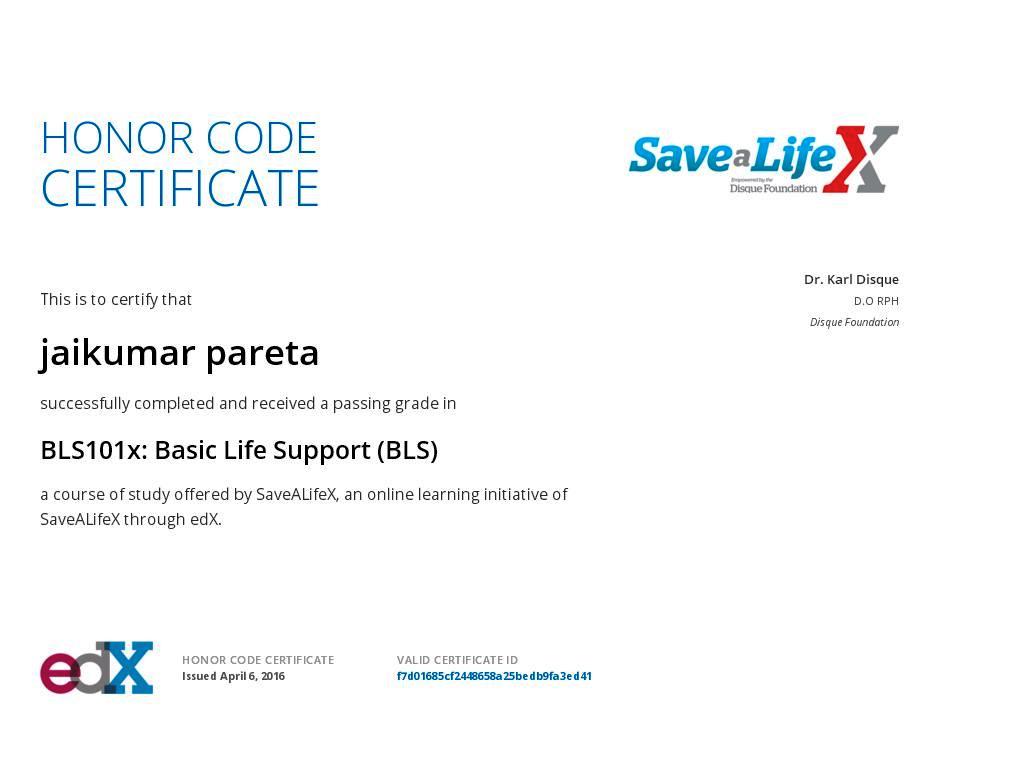
Ø Successfully completed and received a passing grade in Course SaveALifeX: BLS101x Basic Life Support (BLS) Through edx, D.O. RPH, Disque Foundation (USA)
Ø Successfully completed and received a Certificate of Statement of participation in Course Introducing Public health Course code: K311_1, http://www.open.edu/openlearn by The Open University, United Kingdom, Scotland and Wales.
Ø Successfully completed and received a Certificate of Statement of participation in Course Public health in community settings: An introduction, COURSE CODE: K311_2 http://www.open.edu/openlearn by The Open University, United Kingdom, Scotland and Wales.
Ø Successfully completed and received a Certificate of Statement of participation in Course Factors that influence health: An introduction http://www.open.edu/openlearn by The Open University, United Kingdom, Scotland and Wales.

Wednesday, 2 March 2016

Clinical tools for clinical trials by Jaikumar pareta

Testing the safety and efficacy of new drugs is a costly and complex process for pharmaceutical organizations. A clinical trial can cost more than $1 billion and take over 10 years. 


The rising cost and complexity is compromising not only the profitability but also the feasibility of new drug discovery, as the cost burden can have the unwanted effect of stifling research and innovation. The pharmaceutical industry must lower these costs in order to afford bringing new life-saving drugs to the patients that need them. 


As pharmaceutical and biotech companies seek to reduce the cost and time it takes for new drugs to reach the market, the development stage of the drug lifecycle can become a competitive advantage. At the end of the clinical trial pipeline for potentially life-saving drugs and devices are patients who may be desperately waiting for treatment, especially in therapeutic areas such as oncology. Also the sooner a drug can pass its clinical trials, the larger the revenue before its patent expires and generic versions can be sold. Faster clinical trials are the key to first mover advantage and can significantly impact the economics of new drugs. However, there is no single silver bullet that will accelerate clinical trials. Fully optimizing the clinical trials process requires practices and tools that streamline operations, automate processes, increase visibility and improve collaboration with sponsors, CROs, sites, regulators, and review boards. 


The entire clinical ecosystem needs an overhaul and today pharmaceutical companies have access to a variety of cloud-based technologies that can radically improve the clinical trials process. Determining the best eClinical tools to speed clinical trials Sometimes it’s difficult to determine the best tool for a job, particularly when multiple technologies are developed to handle related tasks. Where do one tool’s capabilities end and another tool’s begin? Such is the case with the technologies that pharmaceutical companies can adopt to boost the productivity of clinical trials. Using eClinical systems to speed up clinical trials understanding the roles of eTMF, CTMS, and study startup solutions in the clinical trials process 2 using eClinical systems to speed clinical trials goBalto whitePaper eClinical Systems Accelerate_26 MAY 2015 The initial wave of technology tools focused on the clinical study conduct phase, after subjects were enrolled in the study. Systems that came out of this included clinical trial management systems (CTMS) as well as interactive voice response systems (IVRS) and electronic data capture (EDC) systems. Today, approximately 80 percent of sponsors and 42 percent of CROs use a CTMS.1 Many organizations have also started implementing technology for the submission and closeout phase of the trials process. The trial master file (TMF), which compiles the documents and content that chronicle the conduct of a clinical trial, have evolved from paper-based and file-share systems to electronic “filing cabinet” applications known as eTMF. One-in-five CROs is currently using an eTMF application, while about 36 percent of sponsors are doing so. CTMS and eTMF are specialized systems of critical importance, but neither looks at endto-end improvements in clinical trials, especially in the early stages of study startup. They only squeeze time cycles out of the conduct and closeout stages. 


Purpose-built study startup solutions are needed to fill this void. A study startup solution is not a CTMS or eTMF; it’s the missing piece of the eClinical jigsaw that guides sponsors and CROs through clinical study startup and serves as the repository for in progress documents. eClinical tools need to be assessed as part of the overall picture of clinical study management, rather than just looking at one piece of the clinical trial jigsaw. Each of these tools—eTMF, CTMS, and study startup—plays a distinct role in optimizing the full clinical trials process. However, their individual capabilities have become muddled in a sea of similar terms commonly used to describe their differing functions. These tools perform separate functions but serve overlapping user groups. As a result, sponsors and CROs face much confusion surrounding what each system can and cannot do. In an attempt to bring some clarity to the eClinical stack, let’s dive deeper into these tools. This information is typically stored in a trial master file, or TMF, which historically was comprised of paper documents stored centrally in physical file cabinets. In an attempt to lower costs and expedite the approval processes, the FDA created regulation CFR 21 Part 11 which enables the use of electronic records, digital media, and digital signatures resulting in the birth of the eTMF. Some sponsors and CROs have considered whether they can rely solely upon an eTMF for all documents and to also obtain management information about a particular study. While eTMF systems allow study teams to exchange, review, and archive documents, they:  Can’t track critical activities and milestones eTMFs are limited to document control which reflects only 20% of startup activities such as country and study-specific SSU requirements. They also don’t track non-document activities such as submissions, site visits, training, and supplies which are an important part of the IP release green light milestones. 


 Don’t provide sufficient project management capabilities eTMFs can’t help you forecast and optimize the resources and business processes required to get documents and other startup activities to the end state. Nor can they facilitate all relevant communications between study teams and sites.  Don’t provide visibility into overall study status and bottlenecks eTMFs don’t have the complete view of startup status at the site, local, global, and portfolio levels to enable effective partner benchmarking and study team resource allocation. Without a view into all startup activities, eTMFs can’t provide the realtime study status and cycle times required to identify and proactively manage bottlenecks and keep startup activities on track.  Increase audit issues eTMFs are intended to be the repository for final, approved documents (the source of truth). Using an eTMF to store draft documents, templates, and site communications “dirties up” the eTMF and leaves an organization vulnerable to having these documents exposed during an audit. Information that was abandoned and not intended to be filed can unnecessarily be exposed to regulatory inspectors. CTMS: clinical trial execution and logistics The purpose of a CTMS is to provide operational awareness to the clinical operations department to manage all aspects of the trial process. CTMS solutions were built to be all encompassing but over time the clinical trial space became too complex to model in a single system. Other functions started popping up that required purpose-built architectures. In response, CTMS solutions broke off some of these functions into modules Could the functionality of other systems, like CTMS and study startup, be built into the eTMF? goBalto_whitePaper_eClinicalSystemsAccelerate_26 MAY2015 4 using eClinical systems to speed clinical trials of a monolithic CTMS, such as the medicinal product dictionary, planning, or finance. For other functions, CTMS integrates with best of breed applications that are separate from the CTMS itself to report a bird’s eye view of the trial status. Where CTMS excels is from clinical trial execution forward, after sites are activated. CTMS helps sponsors and CROs manage large amounts of maintenance and recruitment information across a study in order to ascertain if all the sites are filing and to make go/no-go decisions in regular intervals. 

CTMS provides project managers with a centralized source of logistical study information and reports derived from dates and statuses fed to it from several other sources outside the system. CTMS must interact with other eClinical tools, including EDC, finance/ payments and eTMF, in order to extract relevant information and then provide insight into the current operational status of each trial to those managing it. With CTMS, trial supply and logistics can be better optimized; trial managers can more accurately allocate resources and deploy site monitoring where it is most needed. However, because CTMS relies on outside systems for its data, it does not provide progress and realtime performance metrics out of the box. This limits the ability of CTMS solutions to drive extremely time-sensitive and complex parts of a clinical trial like study startup. Study startup: the fastest road to first patient in Study startup is a bottleneck at the outset of clinical trials that slows drug development. The process leading to site activation is complex.

 It requires sponsors to select sites, negotiate contracts, fund and staff the trial, gain institutional review board (IRB) approval, obtain supplies of the drug to be tested, and comply with pre-enrollment regulations. Most pharmaceutical companies still track these site activation tasks and documents using email, clunky spreadsheets, shared file drives, or cumbersome homegrown applications. With multiple parties making updates, materials get out of sync rapidly — this makes it difficult to track the overall status of the project. Historically the study startup process does not help companies manage SOPs, accomplish critical milestones, meet contractual commitments, and compare sites efficiencies, and cycle times. Overall, it is hard to activate sites on time and budget, especially on a global basis where the laws, regulations, and hurdles that can make or break a trial vary tremendously. Today, pharmaceutical companies are adding study startup applications like goBalto Activate, a new breed of e Clinical tool that places study startup requirements as the highest priority. 


These tools are purpose-built to enable sponsors, CROs, and sites to get clinical studies started in the shortest time possible. Study startup applications support communicating, reporting, tracking, oversight, and data management to speed study teams through activation. CTMS systems are intended to manage large volumes of study maintenance and logistical data; however they are not well-suited to support realtime performance metrics goBalto whitePaper eClinicalSystemsAccelerate 26 MAY 2015  using eClinical systems to speed clinical trials Time isn’t wasted assembling and discussing status updates; instead, all stakeholders view this information in realtime using the study startup solution so they share one version of the truth. Real time alerts help decision makers intervene immediately, or before a major setback has occurred, instead of after the fact. This is crucial, since in conventional study startup, intervention usually happens after an issue has occurred, when it’s too late to proactively avoid the problem. Speeding study startup sets the stage for efficient progress across the entire lifecycle. Study startup applications integrate with other e Clinical systems including CTMS and eTMF to help companies optimize the full clinical trial process. 


Thursday, 25 February 2016

3-D printing of Pharmaceuticals by Jaikumar Pareta


 Developed at the Massachusetts Institute of Technology (MIT), computer-aided 3D-printing technology has opened up exciting and revolutionary new possibilities in customized medicines.


Aprecia successfully deployed the technology and developed the world’s first 3D-printed Spritam (chemical name: Levetiracetam), a drug to treat seizures in epileptic patients. Produced by sandwiching a powdered form of the drug between liquid materials and bonding them at a microscopic level, these printed pills are superbly porous and dissolve rapidly on contact with liquids. It’s an unparalleled feature for sure, and one that makes it remarkably effective in its core purpose — countering sudden seizures.
3D printing has enabled the creation of high-dose rapid-dissipation pills, affording doctors reliable customization and complete control over the speed and strength of delivered dosage.
By simply altering a pill’s surface area through the printing of complex shapes, one can control not only the strength of a released dose but also the time over which it’s released. This goes a long way toward making administered dosage safer and far more effective.
Manufacturers can also modify their products according to individual preferences, with customized dose strength, pill size, flavors, and colors to choose from. Assuming easy availability of pharmaceutical compounds in powder form, patients can ditch unwieldy tablets, capsules, or liquids in favor of medicines that are far easier to consume. Customizability is especially useful when preparing doses for patients who find swallowing difficult, such as young children or the physically impaired.
3D printing represents a significant breakthrough in an era of customized medicine and tailored treatments.
This breakthrough technology could also allow manufacturers to shift their production and distribution processes closer to consumers. With constant improvements in design and operational efficiency, printers of varying sizes and capacities could be deployed at bespoke locations that are convenient for patients. Hospitals and pharmacies could manufacture prescriptions on their own premises, eliminating the need to stock vast quantities of generics. They would also be able to produce specialized or uncommon compounds in-house, saving patients a considerable wait, and perhaps saving more lives in time-sensitive critical situations. With such flexibility and scalability afforded to supply chains, both suppliers and consumers can benefit from the low costs and prices that operational efficiencies bring.
Some speculate 3D printing will become so commonplace that patients could even print their own drugs at home.
The technology could, in theory, allow users to print drugs of any size, shape, and dosage with ease. All they’d need is a downloadable recipe, basically a set of instructions that the printer reads and follows. As long as their home printer is stocked with the necessary base compounds, they could synthesize any and every formulation they’d need. It’d be just like using recipes from a cookbook, only it’d take only half as much work:
To make a batch of cookies you’ve never made before:
  1. Find the recipe you want
  2. Download a copy
  3. Print
  4. Follow the recipe
  5. Bake
  6. Clean up after yourself
To make a batch of pharmaceutical prescriptions you’ve never made before:
  1. Find the recipe you want
  2. Download a copy
  3. Print
When it’s easier to make a batch of pills than it is to bake cookies, it ought to make you wonder.
While there’s little scope for tampering in current pharmaceutical manufacturing processes, there’s some concern about its likelihood when implementing 3D printing methodologies. There’s also the possibility of hacked machines producing counterfeit medications or being used to mask illegal drugs as legitimate medication.
The wide reach and global nature of such technologies also means the lines for liabilities are blurry.
Drug companies would need to ensure that their products’ recipes and regulatory norms are adhered to. They’d have to ensure foolproof print processes that are safeguarded against human error as well as sabotage. They would also need to ensure their devices are well secured in case unscrupulous entities try to reverse-engineer proprietary products. Drug regulatory authorities would also have to establish unprecedented guidelines for the approval of mass-marketed 3D-printed drug products.
More importantly, in case of technical errors or malfunctions that result in incorrectly printed dosages that cause harm to or the demise of a patient, who is to blame?
Does the onus fall on the drug company that created the recipe, on the patient who printed the recipe, or on an intermediary that manufactures doses or maintains the machines?
While there are several significant concerns that need addressing before 3D pharmaceutical printing technology goes mainstream, the benefits are well worth the bother.
This technology stands to revolutionize the pharmaceutical manufacturing industry, with possibilities that sound straight out of science fiction. Pills created to release a cocktail of drugs over definite intervals could wrap up a whole day’s worth of dosage into a single, easy-to-swallow pill. Tell grandpa to toss out that old pill organizer; he’ll get everything he needs from a single tab, no fuss or chance to forget. Imagine the possibilities for specialized pills that treat niche ailments, which can be developed and produced at a fraction of current costs, all tailored to your prescription and individual preferences.
making it cheaper because the whole process of testing drugs would become more efficient. While the home 3D printing of drugs may not be possible any time soon, it might be possible to 3D print sample tissues and organs for drug testing purposes. Imagine testing out drugs on 3D human organs instead of on animals or synthetic models. And 3D printing might allow for new types of compounds and medications, based on new geometries and configurations made possible with 3D printing.
Of course, the big wildcard in all this is the approval process of the FDA. Yes, this is the same FDA that sometimes gets blamed for the long process of bringing new drugs to market quickly and efficiently. Add in the “gee whiz” aspect of 3D printing, and it’s easy to see potential regulatory nightmares facing other FDA approvals.
We may never do away with the need for the corner pharmacy to fill prescriptions – but 3D printers could fundamentally change the way patients take certain types of medicine. 3D printers could make possible a world of bespoke medicine in which patients play an active role in bringing their own custom-designed pills to market.


Friday, 19 February 2016

Modern Chip Technology in Life Sciences by Jaikumar Pareta

The healthcare arena is on a clear path towards preventative and personalized medicine.  Measurements of health status are essential in advising patients and healthcare professionals on the most appropriate preventive or curative measures. However, our ability to measure our health status is hampered by the complexity of instrumentation required to acquire that data, and by the complexity of the analysis required to turn that data into actionable information.
But, semiconductor technologies have excelled at making extremely complex instrumentation and data analytics available to consumers at the lowest possible cost. I believe we can tune semiconductor technology such that we can benefit from its power in enabling health measurements anywhere, anytime, by anyone, and at very low cost.
Just look at the Apple A9 chip used in the latest iPhones: It contains more than three billion transistors. That’s pretty impressive on its own — but when you look at its price of around $22 U.S. dollars, it becomes even more remarkable. For decades now, the chip industry has succeeded in offering more and more functionality at increasingly low prices. It is our aim to bring the enormous power of silicon-based chip technology to the life sciences, too.


First and foremost, silicon-based chip technology makes medical instruments smaller and less expensive. In doing so, it makes such devices more accessible to consumers. A good example of this is our project in which we integrate an entire medical laboratory onto a chip measuring just a few square centimeters (cm²). The chip will be capable of analyzing the molecules or cells contained in body fluids (DNA, proteins, viruses, blood cells, etc.) autonomously. This will make it possible to carry out sophisticated tests quickly in places where it was previously impossible: In the hospital ward, at a doctor’s practice, and even in the patient’s home. Continued development of this technology could lead to mainstream, inexpensive DNA tests.
A second reason to bring chip technology to the life sciences is to increase the speed or throughput of medical instruments. Imagine if you were able to read, or sequence, DNA using a chip. It would then become possible to integrate a large number of these sequencing components onto a small area, enabling high-throughput DNA sequencers.
Another great example of chip technology bringing smaller and faster instruments to the life science arena is a new prototype chip called a cell sorter. It’s a device of only 4x2 cm that can analyze a milliliter of blood (e.g. searching for circulating tumor cells). The blood sample flows through a microfluidic channel and, one by one, cells pass over an imager while being illuminated by a laser. Then, based on the holographic image on the sensor, a powerful computation chip reconstructs an image of each individual cell, thanks to lens-free microscopy technology.
The cell is then identified (e.g., as a tumor cell or a white blood cell) and if it is a type that needs to be investigated, it is separated in a distinct microfluidic channel. This is done with the help of steam bubbles generated by miniaturized heating elements in the different output channels, where the live cells are collected for further examination. Such a high-throughput cell sorter chip could be used by medical doctors to do complicated tests on the fly, such as screening blood cells in a patient’s blood sample.
Think of a cancer specialist, who would immediately be able to see if a patient has tumor cells within their blood, or is able to determine if a chemotherapy patient’s treatment should be continued or modified after checking the blood for remaining tumor cells. The cell sorter chip also makes it possible to see if a patient’s blood is contaminated by specific bacteria, allowing doctors to start a targeted treatment immediately.


Chip technology is also of interest for cytometric devices (counting and examining cells), either because the devices themselves can be made smaller and more compact, or because their throughput is enhanced. Counting and examining cells may be of value, for instance, in following up leukemia treatment: A disposable chip can be used to quickly count the number of blood cells so that the doctor can tell the patient — on the spot — whether the treatment is working.

‘Cell sorter' chip that identifies and sorts 3,000 cells per second.

Another application is cell therapy in which human cells are used as medicine. One risk with this treatment is that wrongly programmed cells might be injected inadvertently, which could lead to tumor formation. Cytometric devices are needed to check all of the to-be-injected cells before they are administered to the patient. Thanks to chip technology, this can be done faster, better, and at lesser cost.
Following the famous Moore’s Law, chip technology evolves at a very fast pace. The focus is on developing ever smaller building blocks for the chips, making them faster and more energy efficient. Today’s most advanced chips are made in 20 nanometer (nm) and 14 nm technologies. For the life science applications mentioned above, research centers such as imec are using much ‘older’ technologies, namely 180 nm and 130 nm technology.
This year, imec will go a step further and test more scaled chip technologies. At present, no one knows what these more advanced chip technologies might mean for medical instruments. After all, if the ‘old’ technologies already mean such a revolution for equipment manufacturers, doctors, and patients, it will be exciting to see what the newer technologies will bring to detection and treatment.